


Benjamin Williams Leader RA
British, (1831-1923)The Severn Below Worcester
Oil on canvas, signed & dated 1920, further inscribed to the stretcher in pencil
Provenance: The Cooling Galleries, 92 New Bond Street, London;
M Newman Ltd, 43a Duke Street, London, SW1
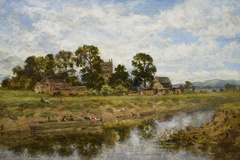
A lovely river landscape painting of the River Severn near Worcester by Benjamin Williams Leader. A canal boat and two rowing boats with figures can be seen moored by the banks of the river Severn. Three further figures are depicted resting on the top of the bankside. In the background, the tower of a village church can be seen along with other buildings. The church and landscape appear similar to that of Kempsey which is located south of Worcester. Leader painted a number of views at Kempsey during the course of his life.
Benjamin Williams Leader was born Benjamin Leader Williams on 12 March, 1831 in Worcester. His father was Edward Leader Williams, a civil engineer and keen amateur artist and his mother was Sarah Whiting, who were both originally from Reading in Berkshire. He was educated at the Royal Grammar School in Worcester and initially followed in his father’s footsteps to become an engineer. During the day he worked at his father’s office but in the evenings studied art at the Worcester School of Design. His father actively encouraged him in his art and he would often accompany him on sketching trips in the Severn Valley, near where he lived.
As a young man, he lived at Diglis House in Worcester with his family and in 1853 became a student at Royal Academy schools, allowing him to advance his artistic studies further. He made his debut at the Royal Academy in 1854 using the name Benjamin Williams Leader probably to avoid confusion with another artist of a similar name. His success and achievements at the RA enabled him to become a full-time artist by his late 20’s. He also exhibited at the British Institution from 1855 and at the Royal Society of British Artists, Birmingham Society of Artists, Liverpool Academy and Glasgow Academy.
He married the flower artist Mary Eastlake on 29 August, 1876 at Buckland Monachorum, Devon. After their marriage they moved to The Lodge at Whittington just outside Worcester. His wife continued painting after they were married and exhibited at the RA. Their son Benjamin Eastlake Leader (1877-1916) also became an artist, most likely receiving tutoring from both his parents.
In 1883 he was elected an Associate of the Royal Academy (ARA) becoming a full academician in 1898. He won a number of accolades during his life including a gold medal in Paris in 1889 and was awarded the legion of honour in the same year, at the instigation of Meisonier. He also won a medal at the Chicago Exhibition of 1893. Leader travelled around England and Wales painting landscapes, particularly in the areas near where he lived such as Severn Valley in Worcestershire as well as Warwickshire, Devon and Surrey. He also spent time in Scotland, Belgium, France, Germany and Switzerland.
Around 1890, he settled at Burrows Cross, near Gomshall in Surrey where he lived for the rest of his life. He died at Burrows Cross on 22 March 1923 and was buried at St James’s cemetery in Shere.
Examples of his work are held by many public institutions throughout the UK including: the Blackburn Museum, Bodelwyddan Castle, Bolton Museum and Art Gallery, Bristol Museum, Dudley Museum, Ferens Art Gallery, Glasgow Museum, Grundy Art Gallery, Guildhall Art Gallery, Harris Museum, Haworth Art Gallery, Kelvingrove Art Gallery, Laing Art Gallery, Leicester Museum, The National Library of Wales , Manchester Art Gallery, National Trust, Towneley Hall Art Gallery, Victoria & Albert Museum, Walker Art Gallery, Wednesbury Museum and Worcester City Museum.
© Benton Fine Art
| Presentation | The work is housed in a new, English made gilt frame which is in excellent condition. The stretcher bears labels for the Cooling Galleries and M Newman Ltd. The Cooling Galleries was established around 1884 by the picture dealer John Albert Cooling. It was originally based at 150 Southampton Row, Fleet Street but moved to 92 New Bond Street in 1911, where it remained until the mid 1970’s. M Newman was an art dealership founded in 1870 by Maurice Newman and originally based at Elisabeth Street in Cheetham, Manchester. Newman later relocated to London around 1891. The business remained in the family after his death and by 1949, was based at 43a Duke Street, St. James’s, London, SW1 and 1&3 Ryder Street. The gallery closed its doors sometime during the late 1970’s/early 1980’s. |
| Condition | As with all of our original antique oil paintings, this work is offered in ready to hang gallery condition, having been professionally cleaned, restored and revarnished. |
Dimensions
| Image Size | 11.5 inches x 17.5 inches (29cm x 44.5cm) |
| Framed Size | 19 inches x 25 inches (48cm x 63.5cm) |
You May Also Like







 The Severn Below Worcester - Benjamin Williams Leader RA

